

使用PyTorch实现DDPG强化学习算法并详细讲解
深度确定性策略梯度(DeepDeterministicPolicyGradient,DDPG)是受DeepQ-Network启发的无模型、非策略深度强化算法,是基于使用策略梯度的Actor-Critic,本文将使用pytorch对其进行完整的实现和讲解DDPG的关键组成部分是ReplayBufferActor-CriticneuralnetworkExplorationNoiseTargetnetworkSoftTargetUpdatesforTargetNetwork下面我
深度确定性策略梯度(Deep Deterministic Policy Gradient, DDPG)是受Deep Q-Network启发的无模型、非策略深度强化算法,是基于使用策略梯度的Actor-Critic,本文将使用pytorch对其进行完整的实现和讲解
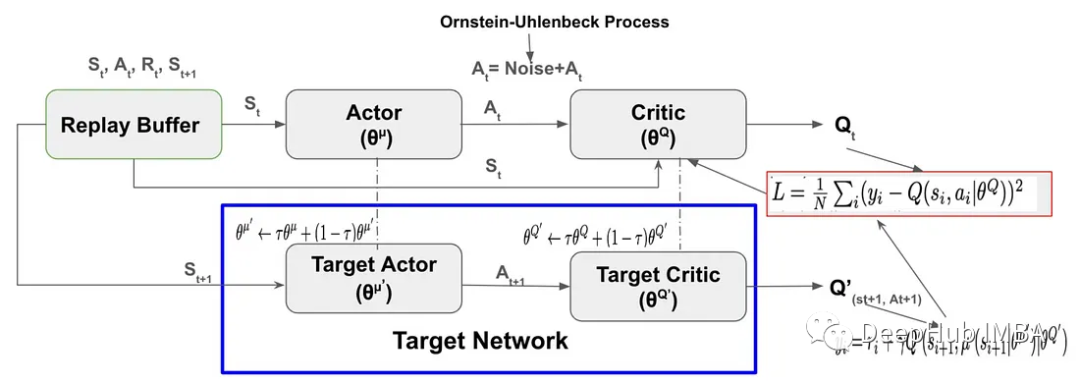
DDPG的关键组成部分是
- Replay Buffer
- Actor-Critic neural network
- Exploration Noise
- Target network
- Soft Target Updates for Target Network
下面我们一个一个来逐步实现:
Replay Buffer
DDPG使用Replay Buffer存储通过探索环境采样的过程和奖励(Sₜ,aₜ,Rₜ,Sₜ+₁)。Replay Buffer在帮助代理加速学习以及DDPG的稳定性方面起着至关重要的作用:
- 最小化样本之间的相关性:将过去的经验存储在 Replay Buffer 中,从而允许代理从各种经验中学习。
- 启用离线策略学习:允许代理从重播缓冲区采样转换,而不是从当前策略采样转换。
- 高效采样:将过去的经验存储在缓冲区中,允许代理多次从不同的经验中学习。
class Replay_buffer():
 '''
Code based on:
https://github.com/openai/baselines/blob/master/baselines/deepq/replay_buffer.py
Expects tuples of (state, next_state, action, reward, done)
'''
 def __init__(self, max_size=capacity):
 """Create Replay buffer.
Parameters
----------
size: int
Max number of transitions to store in the buffer. When the buffer
overflows the old memories are dropped.
"""
 self.storage = []
 self.max_size = max_size
 self.ptr = 0

 def push(self, data):
 if len(self.storage) == self.max_size:
 self.storage[int(self.ptr)] = data
 self.ptr = (self.ptr + 1) % self.max_size
 else:
 self.storage.append(data)

 def sample(self, batch_size):
 """Sample a batch of experiences.
Parameters
----------
batch_size: int
How many transitions to sample.
Returns
-------
state: np.array
batch of state or observations
action: np.array
batch of actions executed given a state
reward: np.array
rewards received as results of executing action
next_state: np.array
next state next state or observations seen after executing action
done: np.array
done[i] = 1 if executing ation[i] resulted in
the end of an episode and 0 otherwise.
"""
 ind = np.random.randint(0, len(self.storage), size=batch_size)
 state, next_state, action, reward, done = [], [], [], [], []

 for i in ind:
 st, n_st, act, rew, dn = self.storage[i]
 state.append(np.array(st, copy=False))
 next_state.append(np.array(n_st, copy=False))
 action.append(np.array(act, copy=False))
 reward.append(np.array(rew, copy=False))
 done.append(np.array(dn, copy=False))

 return np.array(state), np.array(next_state), np.array(action), np.array(reward).reshape(-1, 1), np.array(done).reshape(-1, 1)
Actor-Critic Neural Network
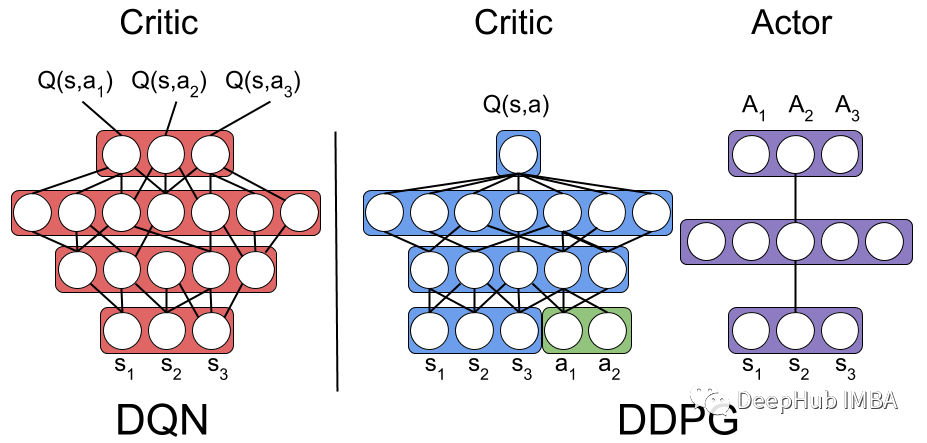
这是Actor-Critic 强化学习算法的 PyTorch 实现。该代码定义了两个神经网络模型,一个 Actor 和一个 Critic。
Actor 模型的输入:环境状态;Actor 模型的输出:具有连续值的动作。
Critic 模型的输入:环境状态和动作;Critic 模型的输出:Q 值,即当前状态-动作对的预期总奖励。
class Actor(nn.Module):
 """
The Actor model takes in a state observation as input and
outputs an action, which is a continuous value.

It consists of four fully connected linear layers with ReLU activation functions and
a final output layer selects one single optimized action for the state
"""
 def __init__(self, n_states, action_dim, hidden1):
 super(Actor, self).__init__()
 self.net = nn.Sequential(
 nn.Linear(n_states, hidden1),
 nn.ReLU(),
 nn.Linear(hidden1, hidden1),
 nn.ReLU(),
 nn.Linear(hidden1, hidden1),
 nn.ReLU(),
 nn.Linear(hidden1, 1)
)

 def forward(self, state):
 return self.net(state)

 class Critic(nn.Module):
 """
The Critic model takes in both a state observation and an action as input and
outputs a Q-value, which estimates the expected total reward for the current state-action pair.

It consists of four linear layers with ReLU activation functions,
State and action inputs are concatenated before being fed into the first linear layer.

The output layer has a single output, representing the Q-value
"""
 def __init__(self, n_states, action_dim, hidden2):
 super(Critic, self).__init__()
 self.net = nn.Sequential(
 nn.Linear(n_states + action_dim, hidden2),
 nn.ReLU(),
 nn.Linear(hidden2, hidden2),
 nn.ReLU(),
 nn.Linear(hidden2, hidden2),
 nn.ReLU(),
 nn.Linear(hidden2, action_dim)
)

 def forward(self, state, action):
 return self.net(torch.cat((state, action), 1))
Exploration Noise
向 Actor 选择的动作添加噪声是 DDPG 中用来鼓励探索和改进学习过程的一种技术。
可以使用高斯噪声或 Ornstein-Uhlenbeck 噪声。 高斯噪声简单且易于实现,Ornstein-Uhlenbeck 噪声会生成时间相关的噪声,可以帮助代理更有效地探索动作空间。但是与高斯噪声方法相比,Ornstein-Uhlenbeck 噪声波动更平滑且随机性更低。
import numpy as np
 import random
 import copy

 class OU_Noise(object):
 """Ornstein-Uhlenbeck process.
code from :
https://math.stackexchange.com/questions/1287634/implementing-ornstein-uhlenbeck-in-matlab
The OU_Noise class has four attributes

size: the size of the noise vector to be generated
mu: the mean of the noise, set to 0 by default
theta: the rate of mean reversion, controlling how quickly the noise returns to the mean
sigma: the volatility of the noise, controlling the magnitude of fluctuations
"""
 def __init__(self, size, seed, mu=0., theta=0.15, sigma=0.2):
 self.mu = mu * np.ones(size)
 self.theta = theta
 self.sigma = sigma
 self.seed = random.seed(seed)
 self.reset()

 def reset(self):
 """Reset the internal state (= noise) to mean (mu)."""
 self.state = copy.copy(self.mu)

 def sample(self):
 """Update internal state and return it as a noise sample.
This method uses the current state of the noise and generates the next sample
"""
 dx = self.theta * (self.mu - self.state) + self.sigma * np.array([np.random.normal() for _ in range(len(self.state))])
 self.state += dx
 return self.state
要在DDPG中使用高斯噪声,可以直接将高斯噪声添加到代理的动作选择过程中。
DDPG
DDPG (Deep Deterministic Policy Gradient)采用两组Actor-Critic神经网络进行函数逼近。在DDPG中,目标网络是Actor-Critic ,它目标网络具有与Actor-Critic网络相同的结构和参数化。
在训练期时,代理使用其 Actor-Critic 网络与环境交互,并将经验元组(Sₜ、Aₜ、Rₜ、Sₜ+₁)存储在Replay Buffer中。 然后代理从 Replay Buffer 中采样并使用数据更新 Actor-Critic 网络。 DDPG 算法不是通过直接从 Actor-Critic 网络复制来更新目标网络权重,而是通过称为软目标更新的过程缓慢更新目标网络权重。
软目标的更新是从Actor-Critic网络传输到目标网络的称为目标更新率(τ)的权重的一小部分。
软目标的更新公式如下:
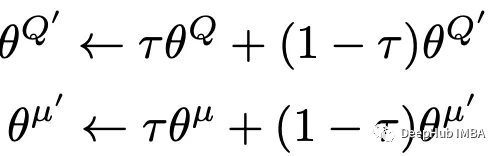
通过使用软目标技术,可以大大提高学习的稳定性。
#Set Hyperparameters
 # Hyperparameters adapted for performance from
 capacity=1000000
 batch_size=64
 update_iteration=200
 tau=0.001 # tau for soft updating
 gamma=0.99 # discount factor
 directory = './'
 hidden1=20 # hidden layer for actor
 hidden2=64. #hiiden laye for critic

 class DDPG(object):
 def __init__(self, state_dim, action_dim):
 """
Initializes the DDPG agent.
Takes three arguments:
state_dim which is the dimensionality of the state space,
action_dim which is the dimensionality of the action space, and
max_action which is the maximum value an action can take.

Creates a replay buffer, an actor-critic networks and their corresponding target networks.
It also initializes the optimizer for both actor and critic networks alog with
counters to track the number of training iterations.
"""
 self.replay_buffer = Replay_buffer()

 self.actor = Actor(state_dim, action_dim, hidden1).to(device)
 self.actor_target = Actor(state_dim, action_dim,hidden1).to(device)
 self.actor_target.load_state_dict(self.actor.state_dict())
 self.actor_optimizer = optim.Adam(self.actor.parameters(), lr=3e-3)

 self.critic = Critic(state_dim, action_dim,hidden2).to(device)
 self.critic_target = Critic(state_dim, action_dim,hidden2).to(device)
 self.critic_target.load_state_dict(self.critic.state_dict())
 self.critic_optimizer = optim.Adam(self.critic.parameters(), lr=2e-2)
 # learning rate


 self.num_critic_update_iteration = 0
 self.num_actor_update_iteration = 0
 self.num_training = 0

 def select_action(self, state):
 """
takes the current state as input and returns an action to take in that state.
It uses the actor network to map the state to an action.
"""
 state = torch.FloatTensor(state.reshape(1, -1)).to(device)
 return self.actor(state).cpu().data.numpy().flatten()


 def update(self):
 """
updates the actor and critic networks using a batch of samples from the replay buffer.
For each sample in the batch, it computes the target Q value using the target critic network and the target actor network.
It then computes the current Q value
using the critic network and the action taken by the actor network.

It computes the critic loss as the mean squared error between the target Q value and the current Q value, and
updates the critic network using gradient descent.

It then computes the actor loss as the negative mean Q value using the critic network and the actor network, and
updates the actor network using gradient ascent.

Finally, it updates the target networks using
soft updates, where a small fraction of the actor and critic network weights are transferred to their target counterparts.
This process is repeated for a fixed number of iterations.
"""

 for it in range(update_iteration):
 # For each Sample in replay buffer batch
 state, next_state, action, reward, done = self.replay_buffer.sample(batch_size)
 state = torch.FloatTensor(state).to(device)
 action = torch.FloatTensor(action).to(device)
 next_state = torch.FloatTensor(next_state).to(device)
 done = torch.FloatTensor(1-done).to(device)
 reward = torch.FloatTensor(reward).to(device)

 # Compute the target Q value
 target_Q = self.critic_target(next_state, self.actor_target(next_state))
 target_Q = reward + (done * gamma * target_Q).detach()

 # Get current Q estimate
 current_Q = self.critic(state, action)

 # Compute critic loss
 critic_loss = F.mse_loss(current_Q, target_Q)

 # Optimize the critic
 self.critic_optimizer.zero_grad()
 critic_loss.backward()
 self.critic_optimizer.step()

 # Compute actor loss as the negative mean Q value using the critic network and the actor network
 actor_loss = -self.critic(state, self.actor(state)).mean()

 # Optimize the actor
 self.actor_optimizer.zero_grad()
 actor_loss.backward()
 self.actor_optimizer.step()


 """
Update the frozen target models using
soft updates, where
tau,a small fraction of the actor and critic network weights are transferred to their target counterparts.
"""
 for param, target_param in zip(self.critic.parameters(), self.critic_target.parameters()):
 target_param.data.copy_(tau * param.data + (1 - tau) * target_param.data)

 for param, target_param in zip(self.actor.parameters(), self.actor_target.parameters()):
 target_param.data.copy_(tau * param.data + (1 - tau) * target_param.data)


 self.num_actor_update_iteration += 1
 self.num_critic_update_iteration += 1
 def save(self):
 """
Saves the state dictionaries of the actor and critic networks to files
"""
 torch.save(self.actor.state_dict(), directory + 'actor.pth')
 torch.save(self.critic.state_dict(), directory + 'critic.pth')

 def load(self):
 """
Loads the state dictionaries of the actor and critic networks to files
"""
 self.actor.load_state_dict(torch.load(directory + 'actor.pth'))
 self.critic.load_state_dict(torch.load(directory + 'critic.pth'))
训练DDPG
这里我们使用 OpenAI Gym 的“MountainCarContinuous-v0”来训练我们的DDPG RL 模型,这里的环境提供连续的行动和观察空间,目标是尽快让小车到达山顶。
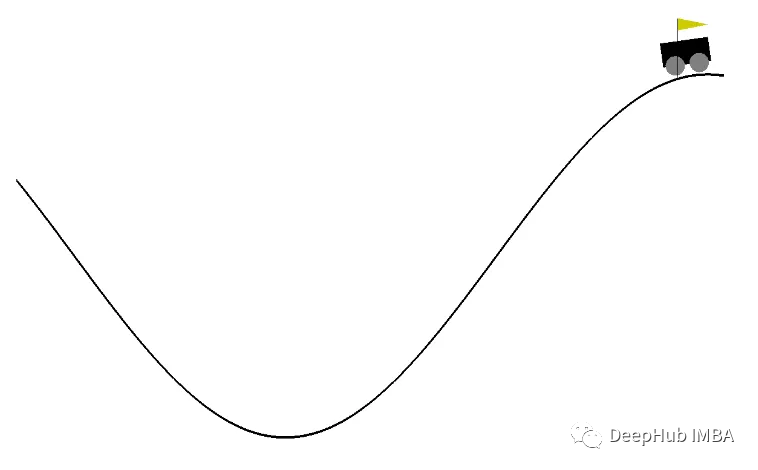
下面定义算法的各种参数,例如最大训练次数、探索噪声和记录间隔等等。 使用固定的随机种子可以使得过程能够回溯。
import gym

 # create the environment
 env_name='MountainCarContinuous-v0'
 env = gym.make(env_name)
 device = 'cuda' if torch.cuda.is_available() else 'cpu'

 # Define different parameters for training the agent
 max_episode=100
 max_time_steps=5000
 ep_r = 0
 total_step = 0
 score_hist=[]
 # for rensering the environmnet
 render=True
 render_interval=10
 # for reproducibility
 env.seed(0)
 torch.manual_seed(0)
 np.random.seed(0)
 #Environment action ans states
 state_dim = env.observation_space.shape[0]
 action_dim = env.action_space.shape[0]
 max_action = float(env.action_space.high[0])
 min_Val = torch.tensor(1e-7).float().to(device)

 # Exploration Noise
 exploration_noise=0.1
 exploration_noise=0.1 * max_action
创建DDPG代理类的实例,以训练代理达到指定的次数。在每轮结束时调用代理的update()方法来更新参数,并且在每十轮之后使用save()方法将代理的参数保存到一个文件中。
# Create a DDPG instance
 agent = DDPG(state_dim, action_dim)

 # Train the agent for max_episodes
 for i in range(max_episode):
 total_reward = 0
 step =0
 state = env.reset()
 fort in range(max_time_steps):
 action = agent.select_action(state)
 # Add Gaussian noise to actions for exploration
 action = (action + np.random.normal(0, 1, size=action_dim)).clip(-max_action, max_action)
 #action += ou_noise.sample()
 next_state, reward, done, info = env.step(action)
 total_reward += reward
 if render and i >= render_interval : env.render()
 agent.replay_buffer.push((state, next_state, action, reward, np.float(done)))
 state = next_state
 if done:
 break
 step += 1

 score_hist.append(total_reward)
 total_step += step+1
 print("Episode: t{} Total Reward: t{:0.2f}".format( i, total_reward))
 agent.update()
 if i % 10 == 0:
 agent.save()
 env.close()
测试DDPG
test_iteration=100

 for i in range(test_iteration):
 state = env.reset()
 for t in count():
 action = agent.select_action(state)
 next_state, reward, done, info = env.step(np.float32(action))
 ep_r += reward
 print(reward)
 env.render()
 if done:
 print("reward{}".format(reward))
 print("Episode t{}, the episode reward is t{:0.2f}".format(i, ep_r))
 ep_r = 0
 env.render()
 break
 state = next_state
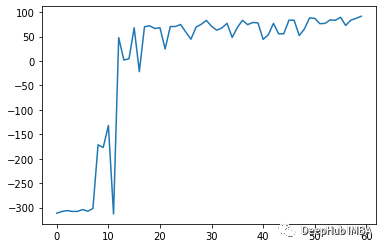
我们使用下面的参数让模型收敛:
- 从标准正态分布中采样噪声,而不是随机采样。
- 将polyak常数(tau)从0.99更改为0.001
- 修改Critic 网络的隐藏层大小为[64,64]。在Critic 网络的第二层之后删除了ReLU激活。改成(Linear, ReLU, Linear, Linear)。
- 最大缓冲区大小更改为1000000
- 将batch_size的大小从128更改为64
训练了75轮之后的效果如下:
总结
DDPG算法是一种受deep Q-Network (DQN)算法启发的无模型off-policy Actor-Critic算法。它结合了策略梯度方法和Q-learning的优点来学习连续动作空间的确定性策略。
与DQN类似,它使用重播缓冲区存储过去的经验和目标网络,用于训练网络,从而提高了训练过程的稳定性。
DDPG算法需要仔细的超参数调优以获得最佳性能。超参数包括学习率、批大小、目标网络更新速率和探测噪声参数。超参数的微小变化会对算法的性能产生重大影响。
深入解析C++中动态数组的初始化机制,涵盖new操作符的不同用法、基本类型与类对象的初始化差异,以及为何在现代C++开发中应优先使用std::vector。

6月29日,中科院计算机网络信息中心等单位发布“异算方舟”国产计算系统软件生态全栈平台。该平台针对算法供给不足、代码迁移困难、智能应用落地慢三大痛点,打造九衍枢算法库、无界BoundX代码转换大模型、Agent-HiReFlow自动化仿真智能体三大能力,提供从底层算法到代码适配再到智能应用的一体化解决方案。

熵基科技发布HuggingZKT算法商城,面向空间智能领域打造端云协同AI算法管理平台,覆盖算法训练、发布、订阅、升级等全生命周期,形成开放高效的算法服务体系,推动园区、楼宇等场景的AI能力敏捷调用,助力空间智能规模化应用迈入新阶段。

芬兰阿尔托大学提出用语言引用原文代替坐标定位,解决视觉文档理解中的归因幻觉问题。实验显示,该方法使归因幻觉率从97%降至28%,证据召回率从个位数提升至50%以上,且答案质量几乎不变。
命名空间的基本概念与常见引入问题在C++等编程语言中,命名空间(namespace)是一种将代码标识符(如变量、函数、类名)封装在特定名称下的机制,其主要目的是避免命名冲突,尤其是在大型项目或使用多个第三方库时。使用“using namespace”指令可以将指定命名空间中的所有名称引入当前作用域,

理解递归的基本原理在C语言中,递归是一种函数调用自身的编程技术。要掌握它,首先需要理解其核心思想:将一个复杂的大问题,分解为一个或几个与原问题相似但规模更小的子问题,直到子问题足够简单,可以直接求解。这个过程通常包含两个关键部分:递归出口和递归体。递归出口定义了问题何时不再继续分解,即最简单、可直接

递归函数的基本概念与适用场景在C语言编程中,递归是一种函数调用自身的编程技巧。它并非适用于所有问题,但在处理某些具有自相似结构的问题时,能提供极其清晰和优雅的解决方案。递归的核心思想是将一个大规模问题分解为一个或多个同类型但规模更小的子问题,直到子问题简单到可以直接求解。典型的适用场景包括树形结构的
理解内存管理的基石在Objective-C的编程世界中,内存管理是开发者必须掌握的核心技能之一。它直接关系到应用的性能、稳定性与资源利用效率。与一些采用自动垃圾回收机制的语言不同,Objective-C在很长一段时间里,依赖一套基于引用计数的、需要开发者部分介入的管理规则。这套规则的核心思想是明确的
理解 dealloc 的角色与时机在 iOS 应用开发中,内存管理是保障应用性能与稳定性的基石。dealloc 方法是 Objective-C 中对象生命周期结束时的关键回调,它标志着对象即将被系统回收内存。正确理解其触发时机至关重要:当一个对象的引用计数降为零时,运行时系统会自动调用该对象的 de
内存管理的基石在Objective-C的世界里,内存管理是开发者必须掌握的核心技能之一。作为一门在手动引用计数(MRC)时代诞生的语言,Objective-C要求程序员对对象的生命周期有清晰的认识。dealloc方法正是这一生命周期中至关重要的终点站。它是一个实例方法,当对象的引用计数降为零时,系统





Windows 10 是一款微软推出的经典操作系统,拥有硬件兼容性与多任务处理能力。它更偏向把系统状态查看和常用调节动作放在一起,适合需要持续观察和微调设备状态的场景。

极度公式是一款跨平台专业LaTeX公式识别编辑软件,支持OCR公式识别和多平台编辑。和使用说明,避免使用,享受完整功能与稳定支持。做扫描整理、文字提取和表格转换时,它能把识别后的处理步骤接得更顺,资料录入这类场景会省下不少时间。