

SpringBoot集成easy-rules规则引擎的流程是什么
一、概述通过将业务规则配置的配置文件中,可以精简代码,同时已于维护,当规则修改时,只需要修改配置文件即可。easy-rules是一个小巧的规则引擎,支持spring的SPEL表达式,同时还支持ApacheJEXL表达式和MVL表达式。二、项目中加入依赖在项目的gradle中增加依赖关系。build.gradle:plugins{id'org.springframework.boot'version'3.0.5'id'io.spring.dependency-mana
一、概述
通过将业务规则配置的配置文件中,可以精简代码,同时已于维护,当规则修改时,只需要修改配置文件即可。easy-rules是一个小巧的规则引擎,支持spring的SPEL表达式,同时还支持 Apache JEXL 表达式和 MVL 表达式。
二、项目中加入依赖
在项目的gradle中增加依赖关系。
build.gradle:
plugins {
id 'org.springframework.boot' version '3.0.5'
id 'io.spring.dependency-management' version '1.1.0'
id 'java'
}group = 'cn.springcamp'
version = '0.0.1-SNAPSHOT'
sourceCompatibility = '17'configurations {
compileOnly {
extendsFrom annotationProcessor
}
testCompileOnly {
extendsFrom testAnnotationProcessor
}
}repositories {
mavenCentral()
}dependencies {
implementation "org.springframework.boot:spring-boot-starter-json"
implementation 'org.springframework.boot:spring-boot-starter-validation'
implementation 'org.jeasy:easy-rules-core:4.1.0'
implementation 'org.jeasy:easy-rules-spel:4.1.0'
implementation 'org.jeasy:easy-rules-support:4.1.0'
annotationProcessor 'org.projectlombok:lombok'
testAnnotationProcessor 'org.projectlombok:lombok'
testImplementation "org.springframework.boot:spring-boot-starter-test"
testImplementation 'org.junit.vintage:junit-vintage-engine'
testImplementation 'org.junit.vintage:junit-vintage-engine'
}dependencyManagement {
imports {
mavenBom "org.springframework.cloud:spring-cloud-dependencies:2022.0.1"
}
}test {
useJUnitPlatform()
}
三、配置文件
示例程序将业务规则放到配置文件中,业务规则配置文件(demo-rule.yml)代码:
name: "age rule"
description: ""
priority: 1
condition: "#person.getAdult() == false"
actions:
- "T(java.lang.System).out.println(\"Shop: Sorry, you are not allowed to buy alcohol\")"
- "#person.setAdult(true)"
- "#person.setAge(18)"
---
name: "alcohol rule"
description: ""
priority: 1
condition: "#person.getAdult() == true"
actions:
- "T(java.lang.System).out.println(\"Shop: you are now allowed to buy alcohol\")"
配置文件中的规则通过 condition 进行配置,当满足规则时,会调用 actions 中配置的动作。
示例项目使用了spring的SPEL表达式进行规则配置,配置文件中配置了2个规则,第一个规则通过 person这个spring bean中的getAdult()判断是否满足规则,满足规则时调用三个方法。
在spring-boot本身的配置文件中 application.yml 配置规则文件:
rule:
skip-on-first-failed-rule: true
skip-on-first-applied-rule: false
skip-on-first-non-triggered-rule: true
rules:
- rule-id: "demo"
rule-file-location: "classpath:demo-rule.yml"
四、代码中对规则引擎进行配置
通过 RuleEngineConfig这个spring的配置类对规则引擎进行配置:
@Slf4j
@EnableConfigurationProperties(RuleEngineConfigProperties.class)
@Configuration
public class RuleEngineConfig implements BeanFactoryAware {
    @Autowired(required = false)
    private List ruleListeners;
    @Autowired(required = false)
    private List rulesEngineListeners;
    private BeanFactory beanFactory;
    @Bean
    public RulesEngineParameters rulesEngineParameters(RuleEngineConfigProperties properties) {
        RulesEngineParameters parameters = new RulesEngineParameters();
        parameters.setSkipOnFirstAppliedRule(properties.isSkipOnFirstAppliedRule());
        parameters.setSkipOnFirstFailedRule(properties.isSkipOnFirstFailedRule());
        parameters.setSkipOnFirstNonTriggeredRule(properties.isSkipOnFirstNonTriggeredRule());
        return parameters;
    }
    @Bean
    public RulesEngine rulesEngine(RulesEngineParameters rulesEngineParameters) {
        DefaultRulesEngine rulesEngine = new DefaultRulesEngine(rulesEngineParameters);
        if (!CollectionUtils.isEmpty(ruleListeners)) {
            rulesEngine.registerRuleListeners(ruleListeners);
        }
        if (!CollectionUtils.isEmpty(rulesEngineListeners)) {
            rulesEngine.registerRulesEngineListeners(rulesEngineListeners);
        }
        return rulesEngine;
    }
    @Bean
    public BeanResolver beanResolver() {
        return new BeanFactoryResolver(beanFactory);
    }
    @Bean
    public RuleEngineTemplate ruleEngineTemplate(RuleEngineConfigProperties properties, RulesEngine rulesEngine) {
        RuleEngineTemplate ruleEngineTemplate = new RuleEngineTemplate();
        ruleEngineTemplate.setBeanResolver(beanResolver());
        ruleEngineTemplate.setProperties(properties);
        ruleEngineTemplate.setRulesEngine(rulesEngine);
        return ruleEngineTemplate;
    }
    @Bean
    public RuleListener defaultRuleListener() {
        return new RuleListener() {
            @Override
            public boolean beforeEvaluate(Rule rule, Facts facts) {
                return true;
            }
            @Override
            public void afterEvaluate(Rule rule, Facts facts, boolean b) {
                log.info("-----------------afterEvaluate-----------------");
                log.info(rule.getName() + rule.getDescription() + facts.toString());
            }
            @Override
            public void beforeExecute(Rule rule, Facts facts) {
                log.info("-----------------beforeExecute-----------------");
                log.info(rule.getName() + rule.getDescription() + facts.toString());
            }
            @Override
            public void onSuccess(Rule rule, Facts facts) {
                log.info("-----------------onSuccess-----------------");
                log.info(rule.getName() + rule.getDescription() + facts.toString());
            }
            @Override
            public void onFailure(Rule rule, Facts facts, Exception e) {
                log.info("-----------------onFailure-----------------");
                log.info(rule.getName() + "----------" + rule.getDescription() + facts.toString() + e.toString());
            }
        };
    }
    @Override
    public void setBeanFactory(BeanFactory beanFactory) throws BeansException {
        this.beanFactory = beanFactory;
    }
}
配置文件中配置了 ruleEngineTemplate这个spring bean,通过ruleEngineTemplate触发规则引擎的执行。
五、执行规则引擎
ruleEngineTemplate配置好后,我们可以在业务代码中执行规则引擎,处理配置文件中配置的业务规则:
最为演示,我们将规则引擎的执行代码放到了 Application 的 run 方法中,程序启动后立即执行规则引擎:
@SpringBootApplication
public class Application implements CommandLineRunner {
    @Autowired
    RuleEngineTemplate ruleEngineTemplate;
    public static void main(String[] args) {
        SpringApplication.run(Application.class, args);
    }
    @Override
    public void run(String... args) {
        Person person = new Person();
        Facts facts = new Facts();
        facts.put("person", person);
        ruleEngineTemplate.fire("demo", facts);
    }
}
程序执行后可以看到控制台里打印了 Shop: Sorry, you are not allowed to buy alcohol,这个内容对应的是我们在规则文件中的actions中配置的 "T(java.lang.System).out.println(\"Shop: Sorry, you are not allowed to buy alcohol\")",说明规则成功执行了。
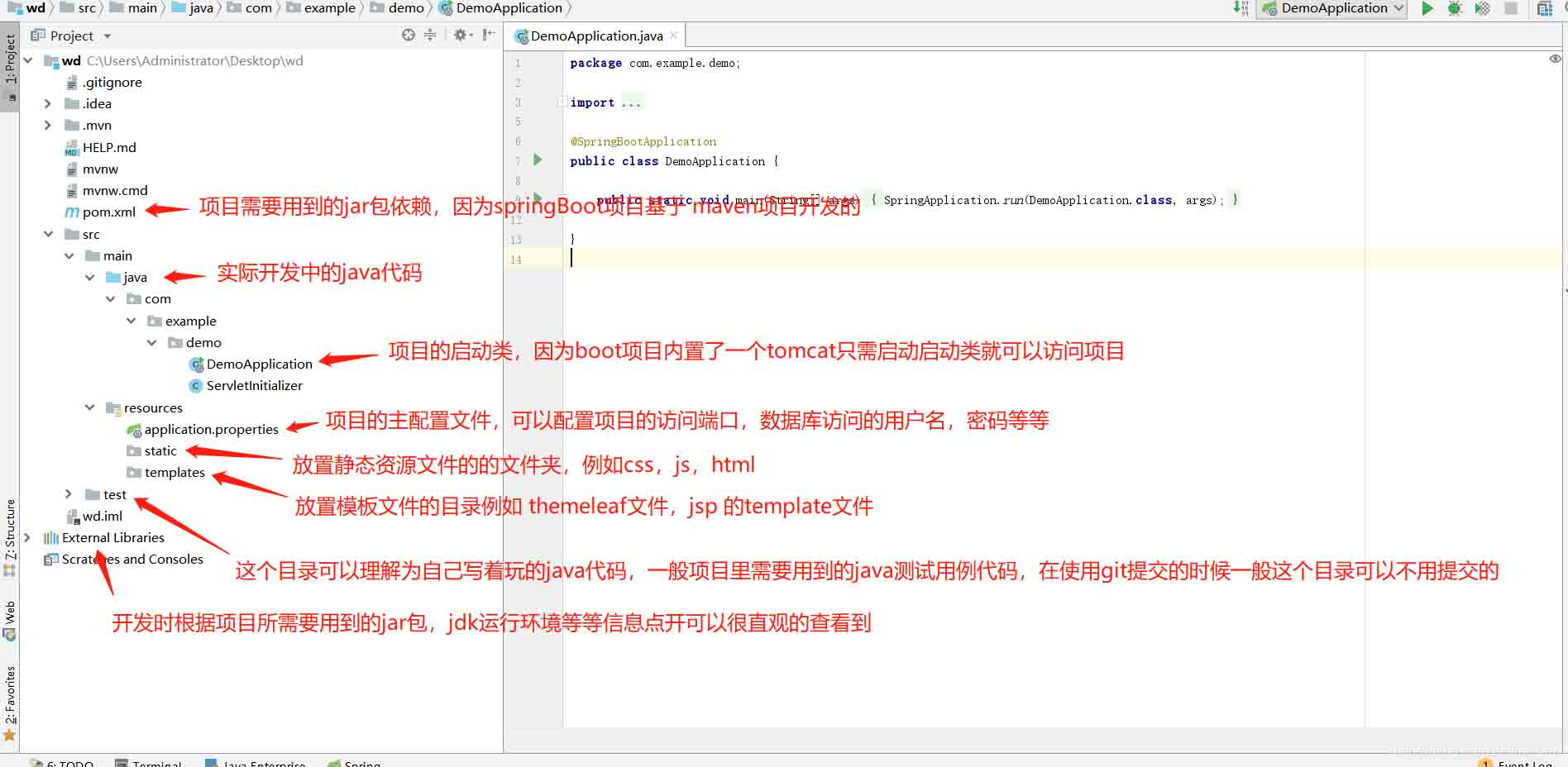
springBoot项目常用目录springBoot项目的目录结构及名规范介绍基于SpringBoot开发时的目录结构及命名规范,通过介绍能够为你解决,在实际项目中如何规划目录结构?如何命名目录更规范?各个目录分别代表什么含义?等三个问题。目录说明servicex//项目名|-admin-ui//管理服务前端代码(一般将UI和SERVICE放到一个工程中,便于管理)|-servicex-auth//模块1|-servicex-common//模块2|-servicex-gateway//模块3|-serv

解析SpringBoot和SpringMVC之间的异同SpringBoot和SpringMVC是Java领域中非常重要的开发框架。虽然它们都属于Spring框架的一部分,但是在使用和功能上有一些明显的区别。本文将对SpringBoot和SpringMVC进行比较,解析它们之间的异同。首先,让我们来了解一下SpringBoot。SpringBo
近年来,随着云计算和分布式架构的兴起,微服务架构的应用越来越广泛。而SpringCloud和SpringBoot作为Java开发中的两个重要框架,对于微服务的实现起到了重要的作用。然而,很多人对于它们在微服务领域的不同应用方式还存在一定的疑惑。本文将从不同的角度探索SpringCloud和SpringBoot在微服务中的应用方式。首先,我们来了解一下Spri
SpringBoot与SpringMVC的不同之处在哪里?SpringBoot和SpringMVC是两个非常流行的Java开发框架,用于构建Web应用程序。尽管它们经常分别被使用,但它们之间的不同之处也是很明显的。首先,SpringBoot可以被看作是一个Spring框架的扩展或者增强版。它旨在简化Spring应用程序的初始化和配置过程,以帮助开发人
SpringBoot和SpringMVC都是Java开发中常用的框架,但它们之间有一些明显的差异。本文将探究这两个框架的特点和用途,并对它们的差异进行比较。首先,我们来了解一下SpringBoot。SpringBoot是由Pivotal团队开发的,它旨在简化基于Spring框架的应用程序的创建和部署。它提供了一种快速、轻量级的方式来构建独立的、可执行
SpringBoot和SpringMVC是Java开发中常用的两个框架,它们都是由Spring框架所提供的,但在功能和使用方式上有着一些区别。本文将分别介绍SpringBoot和SpringMVC的特点和区别。一、SpringBoot的特点:简化配置:SpringBoot通过约定优于配置的原则,大大简化了项目的配置过程。它可以自动配置项目所需要的参数,开发人
SpringCloud和SpringBoot是目前Java领域中最热门的开源框架,它们分别提供了一套完善的微服务架构和快速构建应用程序的解决方案。本文将对它们的功能进行比较,并给出选择指南,以帮助读者了解它们的优势和适用场景。SpringBoot是一个用于开发Java应用程序的框架,它提供了一个简化的开发流程,集成了大量常用的功能和组件,减少了开发者的工作量
深入剖析SpringCloud和SpringBoot的异同引言:在构建企业级应用程序时,Spring框架已经成为开发者们的首选。它提供了一种简单而强大的方式来构建独立于平台的应用程序。Spring框架由两个核心模块组成:SpringBoot和SpringCloud。虽然它们都可以帮助开发者快速搭建应用程序,但它们的目标和用途存在一些差异。本文将深入剖析Spr
从架构角度看SpringCloud与SpringBoot的差异引言:在当今的互联网时代,构建分布式系统已经成为了一种必要的需求。而SpringBoot和SpringCloud正是为了满足这个需求而诞生的。尽管它们都是由Spring框架所提供的解决方案,但从架构角度来看,它们存在着一些重要的差异。本文将从架构的角度出发,对SpringBoot和SpringCl
JavaAPI开发中使用SpringBoot的利弊分析随着互联网的快速发展和技术的不断更新迭代,Java技术在开发中的广泛应用引起了人们的重视。而SpringBoot作为一种微服务架构的解决方案,已经逐渐成为Java开发中的热门选择。那么,在JavaAPI开发中使用SpringBoot,到底有哪些利弊呢?下面来分析一下。利:简化开发





火山引擎是字节跳动旗下企业级云与AI服务平台。聚焦大模型核心能力,依托字节自研豆包多模态大模型,凭借火山方舟一站式平台,提供模型精调、推理部署、智能应用搭建等全链路服务,结合高性能AI算力,助力各行业快速落地大模型数字化与智能化应用。